Engineering the Modern Penthouse: Strategic Weight-Saving with Flexible Stone Veneer vs. 2cm Slabs
Executive Summary for Architects & Developers:
For high-rise penthouse developments, structural load-bearing capacity is often the primary constraint when specifying luxury finishes. While 2cm natural stone slabs offer an undeniable aesthetic, their cumulative dead load (approx. 13-15 lbs/sq.ft) frequently necessitates costly structural reinforcement of the floor slab. Uchain’s Flexible Stone (MCM Technology) provides a high-performance alternative that achieves the same visual depth and texture at a fraction of the weight (comparable to PVC panels), effectively mitigating structural risks while maintaining Class A fire compliance for multi-family residential projects.
1. Technical Analysis: MCM Technology vs. Traditional Masonry
From a specification standpoint, the weight-saving advantages of Flexible Stone are rooted in its Modified Clay Material (MCM) technology. By utilizing a proprietary mix of natural stone powder and clay, we can produce a veneer that replicates the geological characteristics of natural stone without the mass of a solid slab.
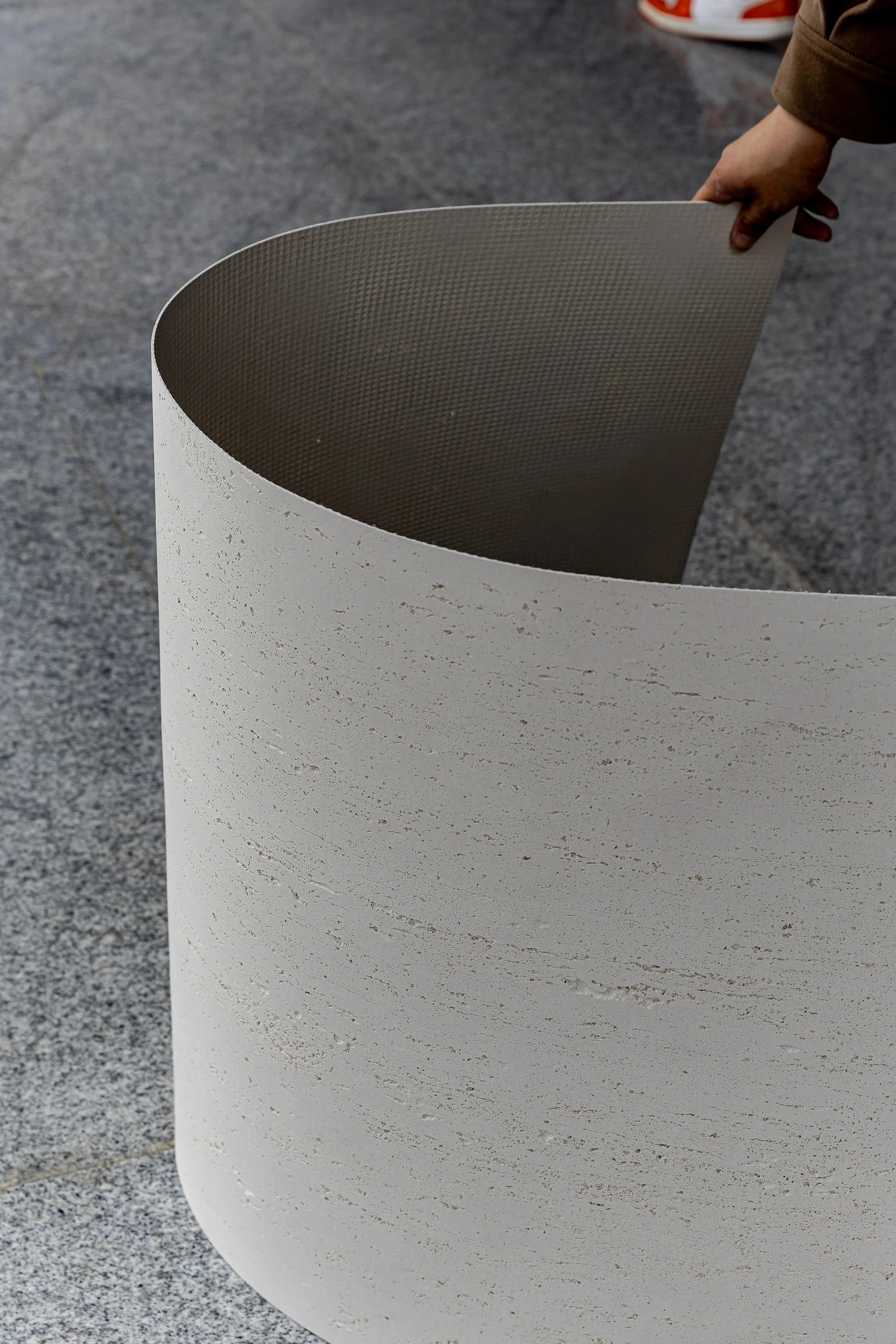
“uchain-curved stone panel”
Key Technical Parameters:
- Composition: Natural stone powder and clay mix (MCM).
- Weight Profile: Significantly reduced dead load, comparable to lightweight PVC panels. This allows for installation on standard drywall or lightweight substrates without additional structural bracing.
- Dimensional Profile: Available in thicknesses ranging from 0.15 to 0.8 inches, offering a slim profile that saves valuable interior square footage.
- Flexibility: Unlike rigid 2cm slabs which require complex miter cuts for curved surfaces, Uchain Flexible Stone offers a minimum bending radius of approximately 20 inches (0.5m), making it ideal for wrapping structural columns or radial feature walls.
2. Comparative Specification Table
The following table outlines the performance metrics essential for penthouse feature wall selection.
Feature Uchain Flexible Stone (MCM) 2cm Natural Stone Slab Average Weight 0.8 - 1.2 lbs/sq.ft (Nominal) 13 - 15 lbs/sq.ft Thickness 0.15" - 0.8" ~0.78" (20mm) Structural Impact Negligible; no reinforcement needed Requires structural engineering review Installation Method Adhesive/Mortar (Tile-like) Mechanical anchors & heavy mortar Curvature Field-flexible (Min. 20" radius) Rigid; Requires CNC/Miter fabrication Fire Rating****Class A (Non-combustible base) Non-combustible Moisture Resistance High (Internal & External Grade) Variable (Porous; requires sealing)
3. Structural and Safety Advantages
A. Mitigation of Dead Load Restrictions
In penthouse units, every pound of dead load counts towards the total deflection limit of the floor slab. Specifying 2cm slabs for a full-height feature wall (e.g., 10ft high) can add thousands of pounds to a localized area. Flexible stone removes this burden, allowing developers to allocate "weight budget" to other luxury amenities like rooftop pools or heavy cabinetry.
B. Seismic and Safety Considerations
In the event of seismic activity, heavy stone slabs pose a significant "fall hazard" if mechanical anchors fail. MCM Flexible Stone, due to its lightweight nature and superior adhesion properties, behaves more like a high-performance tile, significantly reducing the risk of catastrophic failure in high-rise environments.
C. Fire Compliance
For high-rise construction, fire safety is non-negotiable. Uchain Flexible Stone has passed rigorous Class A fire resistance standards. The non-combustible base ensures that your design meets IBC/OBC requirements for high-occupancy residential buildings.
4. Installation Guidelines for Specifiers
To ensure long-term performance and aesthetic integrity, we recommend the following installation protocols:
- Substrate Preparation: Can be installed over standard GWB (drywall), plywood, or concrete. Ensure the surface is flat and primed.
- Adhesive Selection:
- Small Formats: Use high-quality polymer-modified tile adhesive.
- Large Formats: Utilize cement-based mortar, applying the "thin-set" method similar to large-format porcelain tiles.
- Cornering & Columns: For columns or radiused walls, the material can be bent on-site. The 20-inch minimum radius must be respected to maintain the structural integrity of the stone powder matrix.
5. Complementary Architectural Elements
When specifying Flexible Stone, consider the following Uchain solutions to complete the transition details:
- Aluminum Skirting: To protect the base of your feature wall, we recommend our Ultra-slim Aluminum Skirting. It is field-bendable (site-bendable) to match the curves of your flexible stone and is compatible with LED strips for sophisticated down-lighting. These come in pre-finished brushed or matte textures.
- French Trim/Mouldings: For transition to ceiling or adjacent walls, our High-density PU Mouldings provide a lightweight (one-person install) and moisture-resistant solution that can be heat-gun curved to match the wall's radius.
Consultation Note: For specific load-calculation data or samples for your next penthouse project, please contact the Uchain.ca technical desk. Our team of specialists is available to assist with custom shop drawings and submittal packages.